
I’m the very early stages of their publicity, there was alot of talk from busconnects about the nodes, and how we would all have a simpler network, that we might have to take two or more buses to get places, but that it get us there faster. The work has been started, and we now have some great orbital buses, but at the level of the actual connections, there are problems- hopefully these will be fixed.
With the 90 minute fair structure, and some of the existing routes, we have been able to efficiently jump on and off modes of transport. My particular favourite is catching a LUAS and being able to jump off at Heuston or St. James’s to catch a bus to Inchicore (requires careful attention to the real-time)
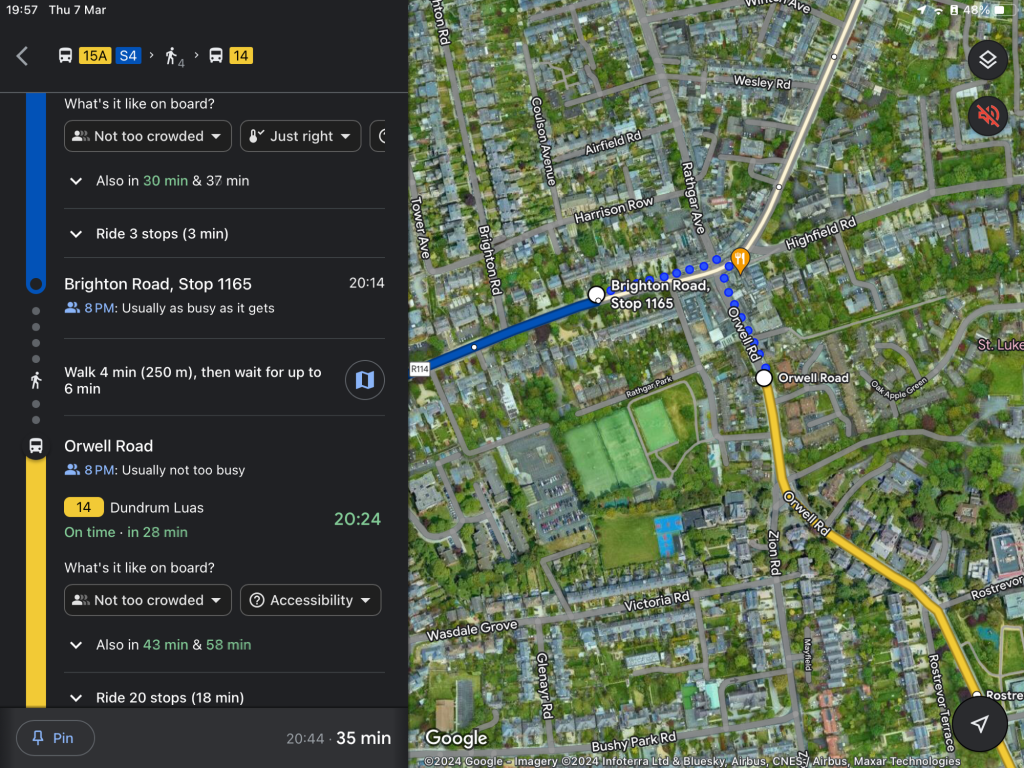
First of all, if there are not bus stops on the two connecting routes, the connection is not going to be straightforward! Rathgar is a busy village, with narrow footpaths, but surely 4 minutes walk between bus stops, if pedestrian crossings allow, isn’t a smooth changeover between the S4 orbitals and the 15s? We can only hope that when the Rathfarnham to City Centre Bus corridor is finished that this will be taken into account.
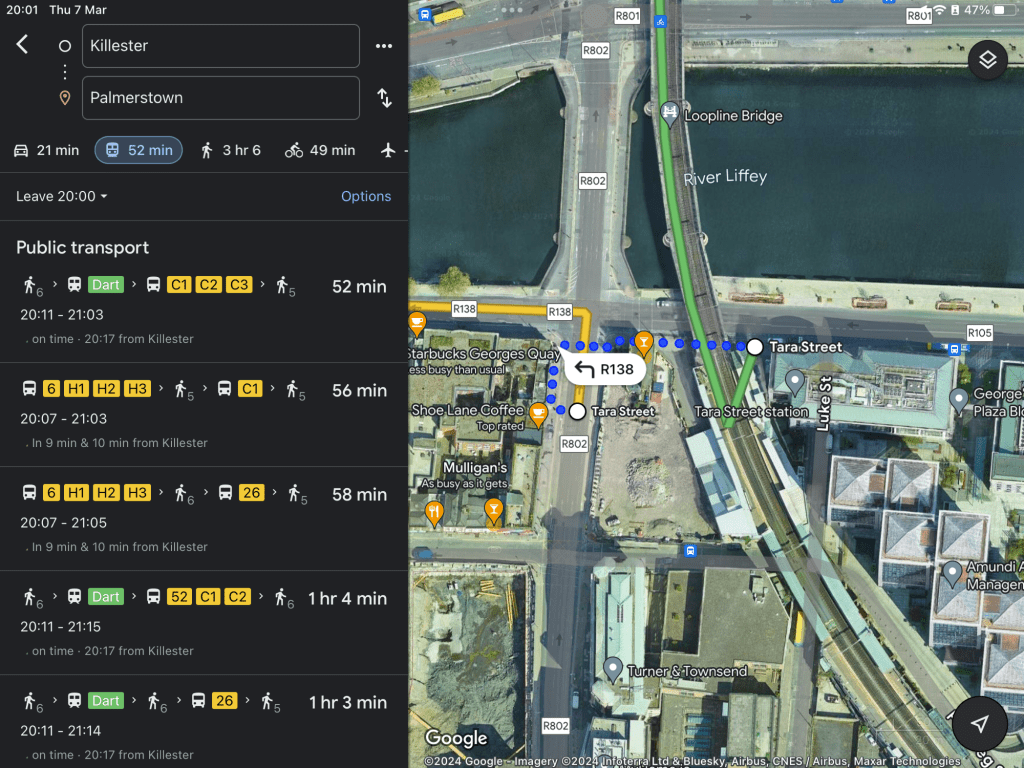
Interchanges with the DART are even more of an issue. The C spine towards the west of the city crosses the DART near Tara Street, and you can get off a DART and onto a C1/2/3/4 quite efficiently:
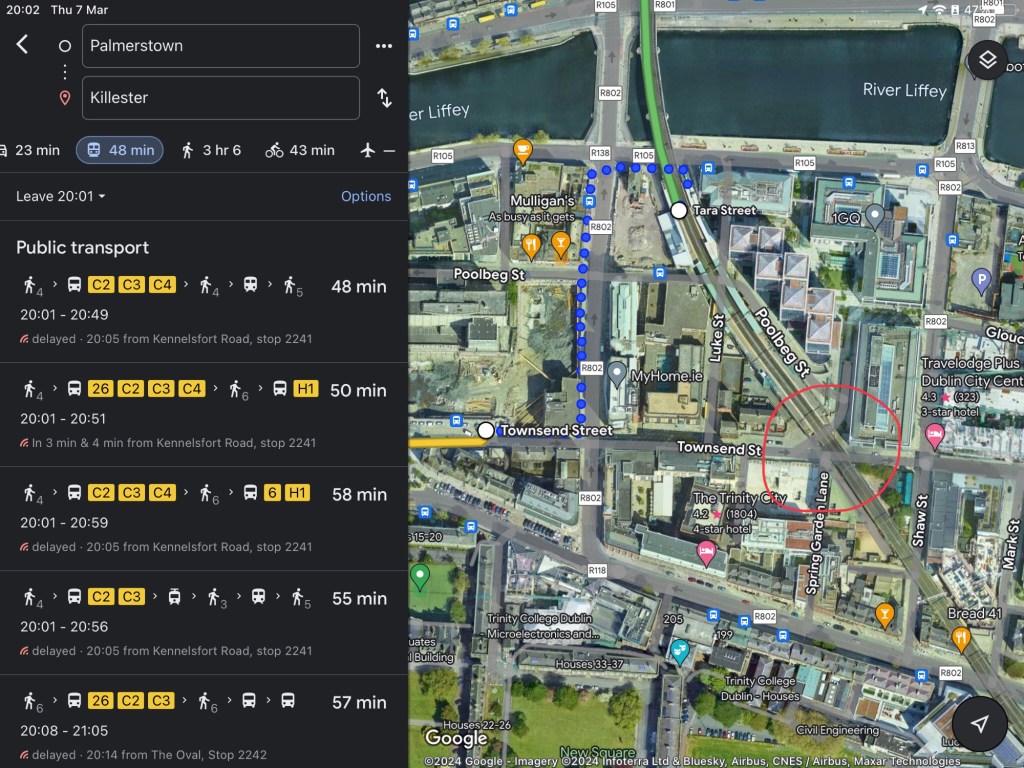
However, travelling the other way is more of a challenge. The recommended bus stop to alight at is on Townsend Street, followed by having to cross Tara Street. An efficient interchange would have been to put the bus stop on Townsend Street at the back entrance to Tara Street DART station, as circled below:
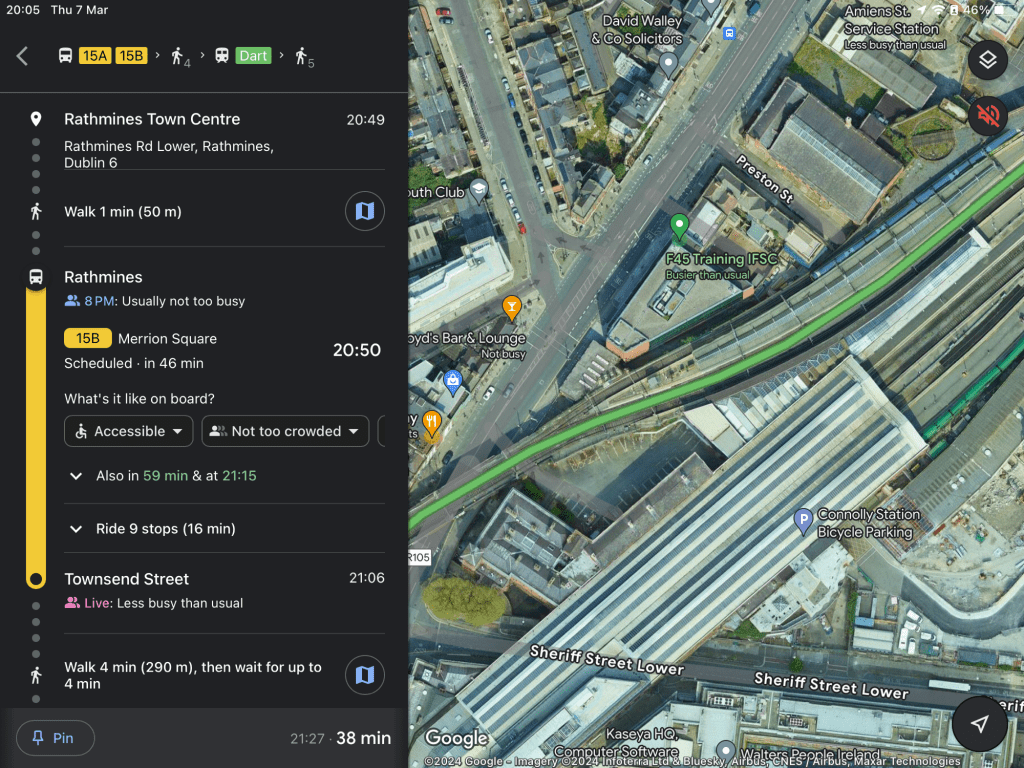
Travelling from Rathmines and trying to catch a DART is less of a smooth transition. You can take a 15 to Amiens Street, but you then have to cross the street and enter the main railway station and walk the full length of the platforms (as shown in the red line below) – Google Maps gets this wrong:
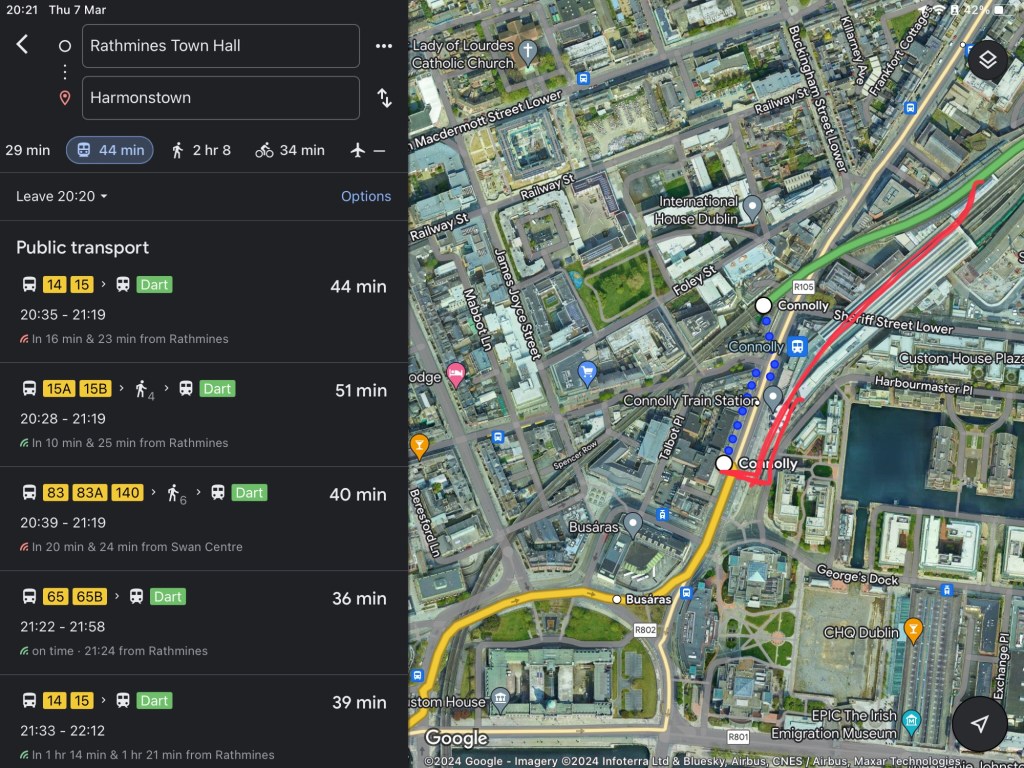
Route 15 to the DART at Connolly (Google Maps)
Closer examination of the map shows the old commuter train station on Amiens Street with direct access to the platforms. This was closed in the 1990s due to antisocial behaviour, and now passengers getting off the DART in Connolly have to make their way up to the main concourse. Ideally, there would be a bus interchange on Amiens Street here, where people could swap seamlessly between the modes of transport. The complete redesign of the street here has been a missed opportunity. There will be a big opportunity nearby here also to link the DART with the planned circular orbital route “O” which will get people around the North Circular Road.
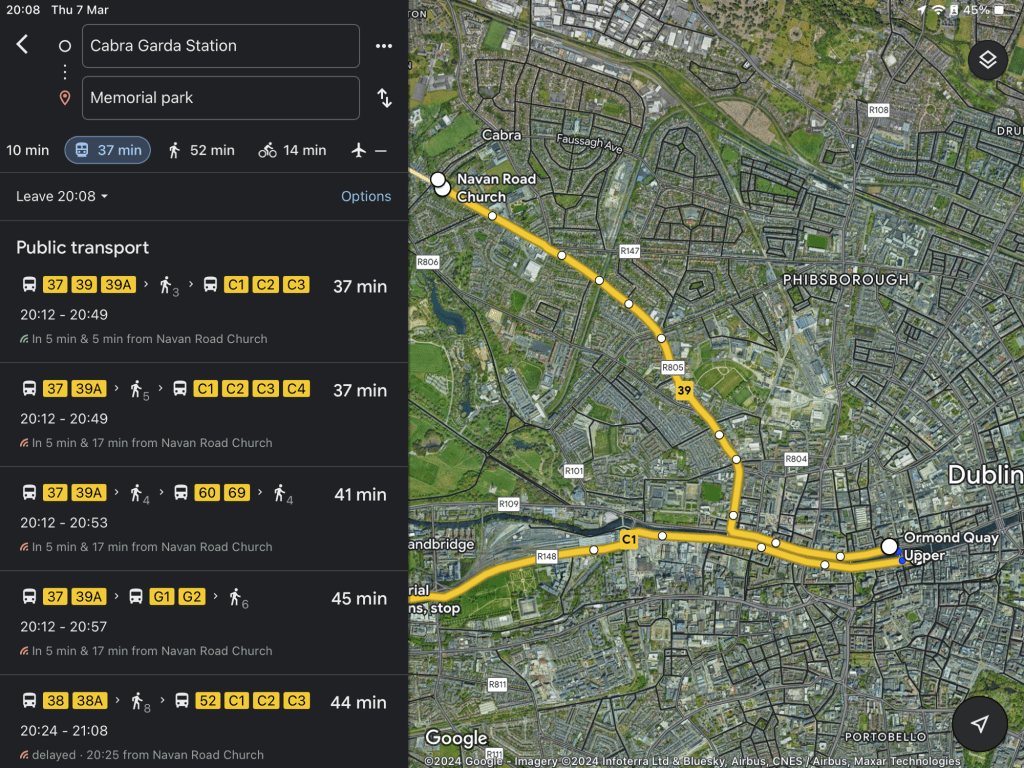
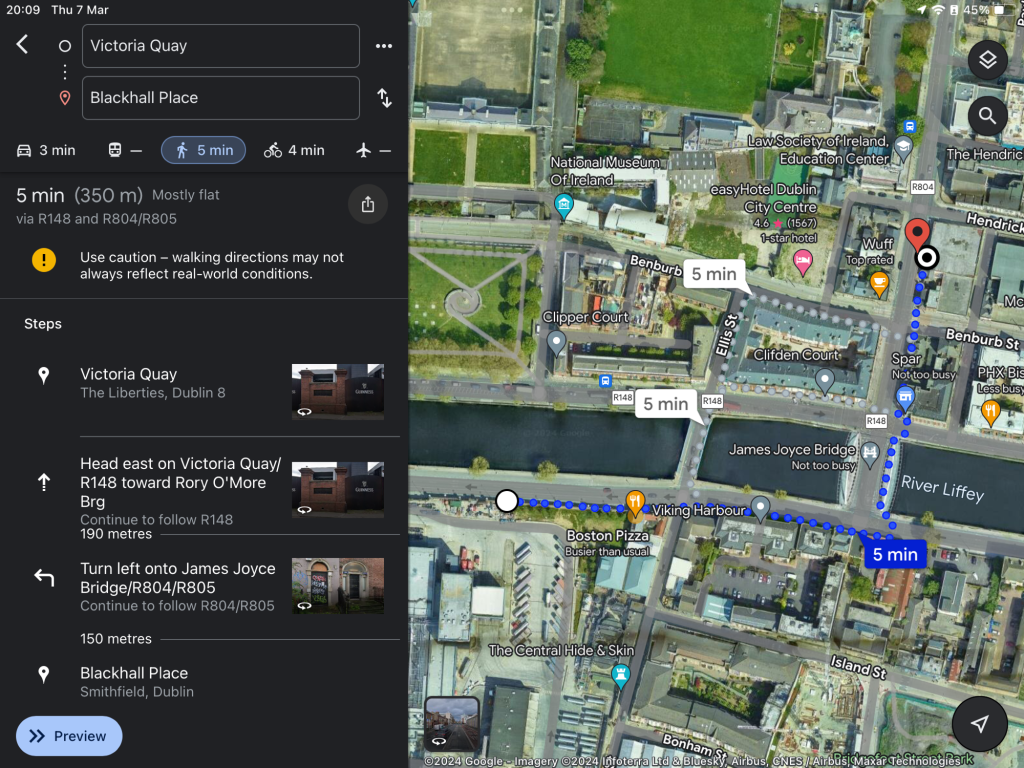
Trying to get a bus from the west to go to to the northwest of the city leads you to the messy interchange shown below, where you are likely to be still on the first bus while you see the one that you want sail by on the other side of the Liffey! In reality, as you can see from the second screengrab, this is not the most efficient way of switching, although the position of bus stops here means that you have a 5 minute walk with the crossing of 4 roads. The switch can be more efficient the other direction, but bus stop positions are still not optimal:
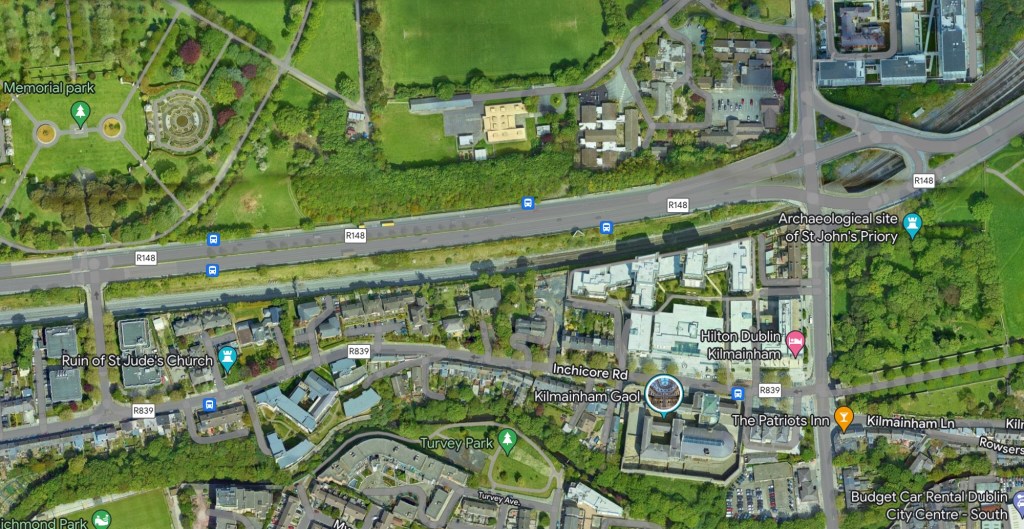
This brings us to the basic concept of bus stop positioning for interchanges. The location of bus stops have been moving further away from junctions in Dublin, possibly on the basis that this might help keep junctions clear. However, the 4 bus stops shown below on Con Colbert Road near the South Circular Road are a perfect example of how to inconvenience bus passengers. There are no residences, no entrances and no gates on this stretch of the road, as to the north you have the Memorial Park and to the South, the railway. These bus stop positions benefit nobody, as the bus stops are all in bus lanes on a wide dual carriageway. Many American cities actually have bus stops only one bus length away from traffic lights (this probably discourages bus lane abuse too – as people are less likely to nip into the lane for a left turn if there is a chance of a stopped bus at the top of the queue).
Here is hoping that as the build infrastructure for bus connects is rolled out, that all bus stops, but particularly those serving connections between bus routes, are moved as close as possible to the junctions. Consideration should even be given to putting them before traffic lights. We need a big shift of people out of their cars, and for this to happen, there needs to be advantages to bus connects. The more we rely on the existing infrastructure and the old routes, the less this is going to be apparent.
(Edited to link here to some useful replied on Twitter from John O’Flahery: https://x.com/johnofladublin/status/1766930736827818489?s=61 I accept his point that BusConnects is not finished, but my point is that the connections still need to be better than they are)


 Oisín Ó hAlmhain