
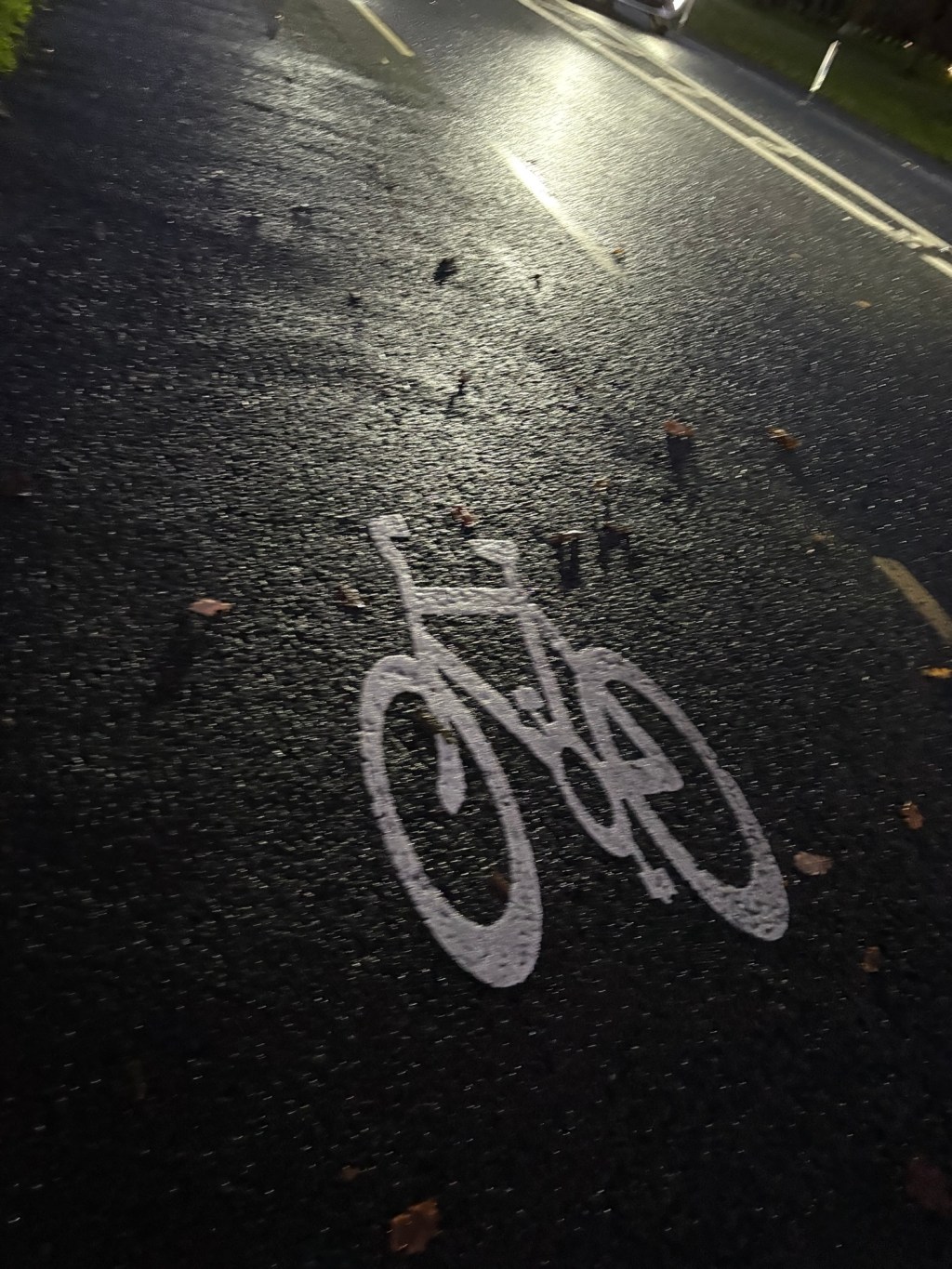
Safety on our roads is everyone’s responsibility, but especially the responsibility of those who by their actions pose more danger to others. However, modern car designs and attitudes have meant that the people who should be taking the most care are not, at the expense of vulnerable road users, who are often asked to dress a specific way (yellow clothes, plastic hats) when going about their day. I have often wondered if a little nudge of enforcement to those who pose the most danger to the health and safety of others might be appropriate, to borrow a phrase from other health and safety strategies: If you spot it, sort it, if you can’t sort it, report it. With this in mind I have tried to report incidents where I have considered driver behaviour to be sub-optimal to an Garda Suíochána (GS) or to the local council, if the problem concerns suboptimal infrastructure.
Before I was aware of the Garda Traffic Watch Service, I sent an e-mail to the GS traffic corps who were then operating out of Donnybrook Garda station, asking what the best approach was for reporting persistent problems. At the time I was mainly concerned with the 2 way cycle lane on Inchicore Road which constantly had cars, buses and delivery vehicles parking on it and on which I had been collided with by vehicles on 2 occasions. There was no response, so I escalated the query to GSOC who promptly lost the file, getting back to me after 2 years to tell me that they had referred the matter back to the Gardai. I then received a letter that did not contain any intelligible information.
In the absence of any access to the local policing board, I then tried sending a similar question through the GS website to the superintendent covering that district. I received a 20 minute long telephone call while I was on holidays outside the country with my family, which provided no information but a promise of follow up with the community Garda, which never materialised.
Reporting to Traffic Watch
For a number of years I made numerous reports to a lo-call telephone number where details were taken by civilian staff of an Garda Suíochána and then passed on to local stations for investigations. The response to these reports was haphazard and there was a variation in response times. Initially, traffic watch staff were able to provide pulse numbers if asked, but this was then shut down, and Gardai stopped providing pulse numbers at all in some cases.
The above system was cumbersome and required a lot of follow up. I made the reports in good faith, and as such did not keep detailed records, as I expected that the system would simply work as it was intended. As all the reports were made by phone and reference numbers were not received, it is is not possible to retrospectively collate the information, but on a few ocassions a Garda got back in touch to tell me that they had cautioned or prosecuted a driver. I was never called to come to court – I am assuming that this was because the reports I made were pretty clear-cut and the driver just took the fixed penalty notice.
In August of 2024 Traffic Watch was moved to an online system which you can find at this link:
https://www.garda.ie/en/trafficwatchreport/
In the following 12 months, I made 33 reports, and as I received a tracking number (not a pulse number) and expressed that I wanted to hear back by e-mail I kept a record. Of these 4 cautions and an FCPN were given out. A further 3 were to do with traffic light offences where there was no video. In about 6 cases the Garda involved decided (for no stated reason) that they did not think that the driving, which was not consistent with the rules of the road, warranted prosecution. 4 incidents are still being processed at this point (almost 6 months after reporting) and in 13 cases no contact at all has been received from any Garda despite the reports. In the remainder of cases footage and/or statements have been provided, but there has been no contact from the investigating Garda.
That’s not a great response rate.
A portal for uploading video of dangerous driving
It has long been part of government road safety strategy that a website would be introduced so that the public can upload videos of dangerous driving. As part of phase 1 of the Government’s National Road Safety Strategy 2021-2030 An Garda Suíochána were to look into this by the end of 2022 (phase 1 of the action plan). In mid-2022 Marc Ó Cathasaigh TD asked the then minister for Justice (Helen McEntee) about this portal, and she gave her views on it, but at this stage 3 years later there is no portal. Concerns about the risk of evidence being compromised were put forward, but it seems to be possible to use data from 3rd parties in many other jurisdictions, including in Britain, which has a similar legal system to Ireland, so the delay seems excessive.
(You can read the question and answer at this link: https://www.kildarestreet.com/wrans/?id=2022-03-29a.216#g218.r
Traffic Light Cameras
Similarly, Roderic O’Gorman TD last month asked the minister for Justice about enforcement cameras at traffic lights, bus lanes, bus gates and other locations where widespread Garda enforcement of road traffic laws is not viable; (https://www.kildarestreet.com/wrans/?id=2025-12-02a.177#g179.r). This has been talked about for over a decade now, and there was even a pilot project at a few sites in Dublin, but still it drags on. On New Year’s Day, the Irish Times reported that the plan was being shelved. In the meantime things drag on.
Taking the workload off An Garda Suíochána
All of the above points to an under resourced and overworked force, and so perhaps part of the solution would be to remove some of the workload, and deal with it elsewhere. What if the Gardaí only had to deal with motoring offences where there was actual or potential danger to road users, and that offences that caused disruption were handled by organisations with remit in those areas such as councils and the National Transport Authority?
Unauthorised vehicles in bus lanes or parked in bus stops could by captured by cameras on board buses or fixed cameras and fines administered by the NTA. This would also apply to vehicles travelling through bus gates or on bus only streets. (Although my preferred approach is hard engineering such as this car trap on a bus lane in England covered by the British Sun newspaper in 2023 )

Where offences were more a problem of contributing to traffic congestion or causing problems for pedestrians and cyclists such as the blocking of pedestrian crossings, junctions or bicycle tracks, or footpath parking, these could be administered by the local authority. This might mean that the money raised could by used appropriately to benefit the victims, as the local authorities are usually tasked with improving pedestrian and cycling infrastructure, and have to repair the footpaths which have been damaged by illegal parking. It might be easier and more efficient for organisations separate from the Gardai to set up reporting infrastructure, as it would be separate from the demands and pressure of dealing with violent crimes or other activities that where the financial stakes are higher.
We could go further and distribute money raised from bus lane abuse to those most affected: bus drivers and passengers by giving a proportion of the funds to commuter advocacy groups and transport employee trade unions.
The same portal could be used for all reports, with the description used to triage the complaints to the correct agency.
Traffic fines could also be progressive, based on the book value of the vehicle – dangers posed by, and affordability are not the same for the driver or a 2024 Range Rover and that of a 2005 Ford Fiesta!
Whatever way you look at it, we need change, as currently our roads are getting more congested and more dangerous. Some enforcement needs to be part of the solution and the resources don’t seem to be where they need to be. Let’s make this simple and ensure that people know that the law will be enforced fairly and transparently and that taking a chance in the hope that you will get away with it is no longer the approach.
 Oisín Ó hAlmhain